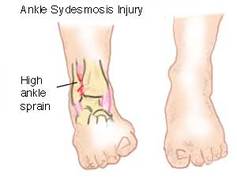
 "CVWC-Affordable Holistic Therapy" This week we are going to look at what many consider one of the most debilitating sports injury, the dreaded High Ankle Sprain! What is the difference? Hold on for this technicality....a high ankle sprain is above the ankle joint; while a regular, good old ankle sprain is below the ankle joint. The major difference is the amount of connective and soft tissue involved. What the brain will do in this instance is allow the muscles and ligaments to go slack so as not to put a sudden and uncontrollable tension on the bone tissue. This normally prevents some type of fracture to the two bones that make up the ankle joint. (Tibia & Talus). The recovery is slightly different as it does affect more of the muscles. Normally this is treated with rest, ice, ultra sound, and electric stimulation. What I have found to Make Them Better is to make sure that the structures are in structural alignment to ensure that the tissue involved is placed in a position to allow healing to take place. Muscle Release Therapy, MRTh® places the proper tension on the joint itself by balancing the unnatural tension that developed during the trauma. Below is an image of the ankle joint. The bones marked tibia and talus make up the ankle joint and the talus must sit directly on top of the calcaneus or heel bone. Use of the joint is almost immediate and recovery is shortened considerably as the tissue begins its healing process without strain. 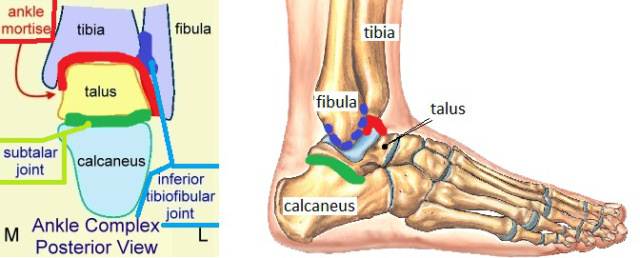
Once the practitioner is able to re-position the structure, it is important to follow the lines of tension as they accommodated for the trauma. There is a major difference between compensation, adaptation, and accommodation for an injury of this nature. As in any trauma, the brain immediately creates a pattern of compensation or counter balancing. What is this compensation? As trauma happens there is an immediate change in tension on the skeleton. That is compensation, what the body does with the compensation is adaptation. Adaptation is what the body does with the compensation; the limp, the limited range of motion, that grabbing pain when sitting, standing or walking. Last but not least is just how the body accommodates for that adaptation. It truly is how the body cheats the system in order for us to function without too much discomfort.
If you want to find out more about your body's accommodation factor, give us a call and we will be glad to discuss this with you. If you have a nagging ankle, knee, hip or back pain, just maybe it is that old ankle sprain you from your high school days. Thanks for reading and remember there is always... a REASON TO HOPE! Dennis 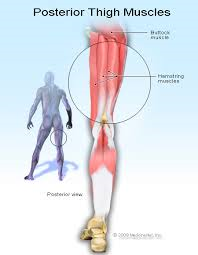 "CVWC-Affordable Holistic Therapy!" (TM) As I begin to write this article on a Sunday evening I am once again astounded by the number of Major League Baseball players who are unable to play because of a strained hamstring, a tight Quadriceps muscle, a sprained ankle, sore elbow and sore shoulder. I am sure that many who are reading this, despite their aches and pains, will report to work on Monday morning. I do realize that in order to play at 100% the player needs to be able to run, catch a ball and swing a bat. In my last article I mentioned the fact that I believe that many of our athletes are over trained and the muscle has minimal ability to function and is a movement away from being dysfunctional. What is meant by this? Most individuals that train for a particular sport have specific activities that they perform that is meant to allow them to perform at a higher level. Why do they have so many injuries then? Overuse is the answer. Most times the repetitiveness and performing improperly because of a fatigue factor will cause the muscles needed to shut down and learn to rely on muscles of adaptation for movement. We will look at the Hamstring muscle group in this article. The Hamstring muscle is made up of four different muscles that work as the opposing muscle to the Quadriceps (front thigh muscles). It is a muscle group that is often described by many as tight like Banjo strings and will limit many professionals as well as weekend athletes. In Fundamental Movement (SM) these muscles have two functions: the first being they do work with the Quadriceps muscle group in bending and straightening the knee joint. Secondly, they act like puppet strings to help in positioning the pelvis. This is their functionality and how they assist the Quadriceps muscle. In the majority of cases these muscle are over used and during the different activities are prohibited from moving through a full range. They are often used also as muscle of dynamics and in reality are primarily muscles that help posture the Pelvis. What this means is that the muscle fiber instead of adding to the dynamics of movement become the primary muscle and the body is just not designed in that fashion. I have found that once the muscle is released using Muscle Release Therapy, MRTh® and a proper movement pattern is re-established that the proverbial tight Hamstring become very functional and are no longer "tight". In traditional activities that individuals perform, individuals move too fast through the movement process and hinder the proper muscle response. Professional athletes do quite a bit of plyometric work to create what they feel will help them be more explosive in their movement. In the majority of cases they limit the range of motion in the fiber and will often create an improper tension on that portion of the skeleton and associated joints. This I find to be the root cause of the injury. By developing an environment of abnormal tension will set the internal structure up for failure. "I will make them better!" How and why? With the hamstring muscles we will reduce the unnatural tension and take away the holding patterns they are in. Once these holding patterns are removed that group of muscles will function at the level they need to. Many that come in complaining of their hamstrings are often amazed that the restriction they experienced goes away without ever touching them. Many tell me to get in there and work them deeply but that is not the answer. The depth of the Muscle Release Therapy, MRTh® does go the level of the skeleton (bone) but without pressure. We use the tissue to create the change by accessing the nerve response needed to balance the movement. Till next time, remember even if the Hamstring is injured, proper rebalancing to it will allow it to become healthy again and allow it to truly function in the right way. Next Wednesday evening (April 23, 2014) I will be presenting a webinar on the movement of the lower extremity and also for the manual and movement therapist a short demonstration on how to balance it. Call 216-364-0152 for details. .....there is always A REASON TO HOPE! Dennis  CVWC-Affordable Holistic Therapy (TM)
The above caption, "I'll Make Them Feel Better", is a play on words of a Cleveland Attorney but truly implies what we are able to do here at CVWC. The other evening when I came home from the office, Marge stated I should be more confident and speak boldly about what Muscle Release Therapy, MRTh® is capable of doing. This topic of discussion came about when Tiger Woods announced he had surgery for a pinched nerve and would miss the Masters Golf Tournament. Recently I have other clients also tell me that I need to let the local Professional sport teams know that I could keep their players healthier and lessen the amount of lost time to the team. In fact one of my clients went so far as to calculate time lost by one of the Cleveland Cavaliers for back issues and figured the team could have paid me five million dollars and still saved money. What seems to be normal injuries should be able to be prevented and/or corrected in a much more reasonable time frame. Most of these injuries are what we deal with on a daily basis here at the center. Pinched nerves, low back pain, neck pain, hip and shoulder pain, plantar fascia, and many other maladies that the every day person deals with will often put a professional player on the sideline for prolonged periods of time. What can be done with these issues to help prevent them? Professional athletes train at a much higher level than the average person, and in my professional opinion are over doing it. I believe this is the cause of the majority of injuries that they sustain. During our last class on Strength Exercise it was proven that too much "exercise" is counter productive. My philosophy is that if proper movement patterns are initiated and repeated, a natural strengthening to one's body will take place. I am also of the belief that directed high intensity strength exercise will enhance the individual's ability to become stronger both physically and mentally, and will properly re-enforce neurological pathways to direct that strength in a proper format. When athletes "strain a Hamstring", incur a high ankle sprain, or any of the multitude of injuries that they have that ultimately prevents them from playing, know that all is correctable and in many cases preventable. How am I able to make these statements? It is a simple process of maintaining a proper tension on the skeleton. This allows the structure to be better able to adapt to the sudden changes in tension that present themselves throughout the course of practice and games. Muscle Release Therapy, MRTh® is both a theory and technique that addresses improper tension on the skeleton and brings it to a natural balance. As the practitioner finds the imbalance in the skeleton and re-enacts the movement process that was abruptly halted, the tissues that are holding the tension return to a natural position. This natural position will reduce the internal stress on the skeleton and allow the brain to use the natural pathways of movement. This will allow damaged tissue to heal, reduce the amount of energy that brain was producing to try and counterbalance or compensate for the injury, and re-establish proper movement patterns. Over the course of the next few weeks, I will isolate some of the more common injuries that not only athletes incur, but the average person often will find disabling. If you have a specific problem you would like me to address, please email me at dennislmt@chagrinvalleywellness.com and I will be happy to. On the top of this page you will notice our new slogan, "CVWC-Affordable Holistic Therapy!" (TM) During March we instituted Throw Back Thursday's and on April 1st I personally reduced all of my rates by 20%, as well as the rates on Therapeutic Massage, Relaxation Massage and Cranial-Sacral Therapy. Call 216-364-0152 for your appointment with one of Licensed Therapist's. Remember there is always a REASON TO HOPE! Dennis 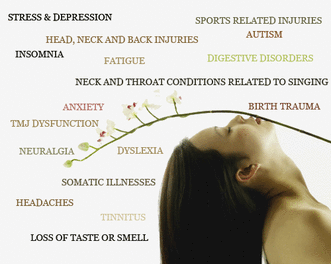 This article will talk about something that my family has recently witnessed when my wife Marge suffered a brain aneurysm on July 27, 2013. Because of her quick response to it she has survived, but over the past 7 1/2 months has had to work diligently to aid her brain in developing new pathways. Our family is blessed that she has had this opportunity to recover.
Even though I have been a holistic health care practitioner for 28 years and have investigated how the brain creates and generates the simplest of movements, I have been truly amazed at just how intricate the brain is. In today's world we are hearing more and more of brain injuries, primarily because of all of the concussions in professional sports and the returning veterans from the wars in Iraq and Afghanistan. A few months back, I had a individual come in with chronic neck and low back pain and during the intake of information I had inquired if he ever suffered from a head injury. He stated, "No, I never had any form of head injury." As many of you know as we begin to release the abnormal tensions of the body through educated touch we also release emotional information that is being stored in the brain. Further conversation revealed he was a veteran of U.S. Marine Corp and had served in the first gulf war. He was exposed to daily barrages of Scud missiles while stationed in Kuwait. Those concussive explosions had altered his posture and did give him BTI. This is just one example, others would be a Brain Aneurysm, Stroke, Auto Accidents, accidentally bumping your head, a hard sneeze or cough, or someone just slapping you on the back unexpectedly. In the picture, it lists many different forms of BTI that we may suffer from. What can someone do to help with these conditions? I will list a few items that I have found helpful and give a brief explanation of how and why. The first being:
Brain Trauma Injury takes on its own form with each individual, and these aforementioned techniques are different ways of taking care of the resultant symptoms. Brain Trauma is more than bumping your head and bruising your brain, it is any alteration to the brain's normal ability to function. As in Marge's case, it was a severe brain bleed, or in a loved one's stroke, a depletion of nutrition to the brain cells, whatever the instance, there is a need to assist the brain to properly function again. Given positive assistance it will respond. Give us a call at 216-364-0152 and one of our therapist or instructors will be happy to assist you on your journey of recovery. On a final note I want to let everyone know I am back on a regular schedule at the office. For everyone that was considerate enough to give me the space and time needed to aide Marge, thank you. Now is a good time to get your body ready for the Spring and Summer weather that is rapidly approaching. and remember there is always a REASON to HOPE! Dennis 
Meditation
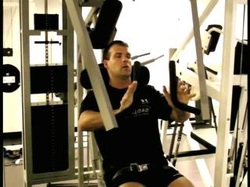 Strength Training Strength Training To many of you these seem like two very far off topics but are very close in application. The mind has to be focused in order to accomplish both, whether a deep, calming place you can go to, or moving a stack of weights. I remember one instance when we had Yoga at our studio one of the clients came to me and said I didn't take Yoga to lay there at the end and sleep. I believe the focus of the exercise was lost somewhere between the beginning and end. On March 12th Joan Leppla will be leading us in a group meditation session, and she will be explaining all of the fine points to remove the craziness of our brain at that moment and going to a place within, where our brain can become quiet and rest. On March 18th Josh Trentine (pictured above) and myself will be conducting a class on the importance of Strength Training and how it truly takes us within to allow our brain to focus on efficient use of our muscle system. Just how do these two tie in together? In the above picture you will see an alignment of different colored circles, these are know as our chakras or energy centers. Many think this is hocus pocus but in reality these are where bundles of nerve endings come together to help us balance our body's systems. Meditation brings these centers into alignment and reduces the amount of stress on the brain as it tries to sort this out among all of the daily chaos. As Joan leads you through the process you will experience a peaceful sensation as these centers of energy become more aligned. In strength training much of the same happens, it is not how much weight you move or how many times you perform a repetition, it is using your body's combination of muscle and skeleton in its most efficient manner and isolating specific muscles to perform that activity. What happens is the brain develops a pathway to move through and the more muscle fibers you are able to use, the less stress is on the brain. When performed properly, strength training shouldn't make you look like the Incredible Hulk, it should give you a long lean look. What gives you the bulky look is the increase in the number of fibers that you are now able to access. 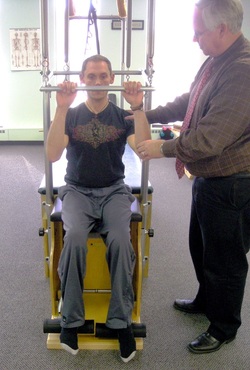 Meditation and strength training take on many different appearances. In the picture on the left, Jarvis is performing a move called the gator. Notice how in all of the pictures, you will see an alignment that places the body into a position where it balances the structure.
So whether its meditation, strength training with weights, or strength training on Pilates equipment we are looking at the same process. We are minimizing stress on the skeleton to allow the brain to balance the internal tension that we need to bring a healing to the whole body. Please join us during the month of March as we explore these areas. Go to our web site, www.chagrinvalleywellness.com, to find out more on the times and cost. Thank you and I know I speak for many, Spring can not come fast enough. Stay warm and I look forward to seeing many of you at the center to partake in these opportunities. Remember there is always.... a Reason to HOPE! Dennis 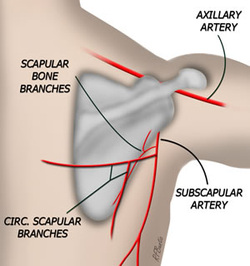 This is a picture of our shoulder blade, anatomically called the Scapula. I choose this one because of the corresponding pictures of the blood vessels underneath it.
This blog will be two fold, first it will be a continuation of the last two on breathing; secondly, hopefully it will help answer a few questions about winter weather. This pertains mainly to us in the area of snowfall and cold weather. This winter that has encompassed the majority of the United States. I will start with the cold weather aspect first. For those, and once again that seems to include most of the United States, we have had a couple bouts of Arctic Cold. Whether it is -5 degrees in Cleveland, OH or 20 degrees in Atlanta, GA, when that cold air hits us we have a tendency to hold our breath when we first walk out into it. There is also a tendency in the cold and icy weather to move differently. As we hold our breath our Shoulder Blade (Scapula) wings out, or it should if we are balanced properly. Well as you can see in the picture that would impede normal blood flow into our upper extremity and slow down the warming process, therefore exposing the arm and hands to get cold. What is not shown in the picture is the nerves that run underneath this bony structure, but they too would become trapped and therefore produce numbness and a cold feeling. The cold feeling comes from the muscles being unable to properly work and they are the major heat producers. In Muscle Release Therapy, MRTh® the first balancing technique taught is balancing the breathing movement chain or kinetics. As we inhale and the top of the pelvis moves inward as the rib cage extends, the shoulder blades move toward the shoulder joint. This permits the body or anatomical structure to open and allow the lungs to expand. When they do not we slow down the amount of oxygen that is taken into the system. Notice the next time you go out into winter weather, we hunch forward in our posture to protect ourselves from the weather conditions. Now picture yourself, whether working on a computer, checking your smart phone messages, watching TV in your favorite chair and many other every day activities, how often our your shoulders slumped and rounded forward? Every time we do this we impede the breathing process and not only change the shoulder position but our abdominal (stomach) region and our pelvis. As many already know my opinion of sit-ups and abdominal or core strengthening, this also impedes the true breathing process. Now I am not saying we should ignore this area, but sometimes the focus is too often their not truly understanding what complications it brings. Our true core goes from the inside part of the knees upward to our shoulder blade region, and this is what needs to be addressed. By over strengthening the proverbial six pack muscle you force the body into a stare of leaning forward just as you do in cold weather movement. This leads to back pain and other common complaints that are treated at our Wellness Center on a daily basis. Your homework this week is to ensure that your shoulder blades move out when you inhale and in when you exhale, if not you need to get that balance reinstituted so that you are able to prevent everyday aches and pains. As you inhale many of us do not feel the pelvis move but we all can sense the upward movement of the upper rib cage and the sliding of our shoulder blades outward. Remember keep your jaw joints loose during this process, because believe it or not they too are tied into all of this. We will discuss the neck and skull in our next blog. Just how does the shoulder blade move? First of all, there are many balancing muscles that are attached to it that direct its actual movement. Underneath it though is a layer of fat tissue that not only allows it too move but protects the structures that lie between the shoulder blade and rib cage. Many times in the elderly we see this fat pad missing and the rounded back and shoulders. This comes from many years of bad movement posture. Let's move into our golden years keeping the fat that we need. Starting on February 13, 2014 I will be conducting online continuing education courses on our breathing structure, and although they are directed toward the professional therapist anyone will benefit from the information. The anatomy of each area will be discussed and how it truly functions. This information will help the lay person as well, in that it will help you not only exercise more efficiently but also perform daily activities easier. My hope is that we understand the need for proper breathing and the importance of our movement posture. If you are experiencing chronic back pain or neck pain, give us call and the therapists and instructors will be happy to discuss your situation with you. Whether you come for Muscle Release Therapy, MRTh®, Pilates, Cranio-Sacral Therapy, or Acupuncture this is always one area that is initially addressed. Thank you and stay warm, breath well and remember......There is always A Reason to HOPE! Dennis 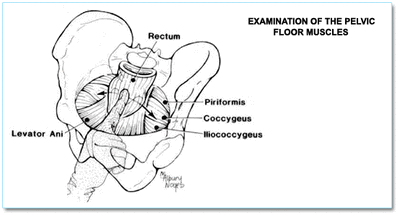 Pelvic Floor Muscles Pelvic Floor Muscles In the last blog we talked about the different diaphragms of the human body and their importance in Fundamental Movement(SM). This week we will briefly discuss the Pelvic Floor, one of the main diaphragms of the body.
This picture depicts the complexity of the muscle structure. The muscles as you see them here helps in the dynamic movement of the bone. When the Pelvis moves it has an upper and lower bowl. As the upper opens the lower closes, this allows for controlled positioning when performing many different movements throughout the day, including breathing. This structure acts as both a support structure and hanging structure, as the lower extremities emanate from here. One of the most notable movement's that takes place here is of course child birth; as the contractions begin the upper portion opens and as the baby moves through the birth canal, the upper portion will start to close and aide in the push for the baby's delivery. It is the contraction, both shortening and lengthening, of these muscles that also aide in the breathing process. As we inhale they will shorten and pull the lower bowl inward and open up the upper bowl. This will lift the pelvic floor contents and the movement process will in turn strengthen the Pelvic region. As we exhale, the upper bowl will start to close and will ensure a straight pull through the spine and aide in balancing the body. For the therapist and movement specialist, lets look at the process that needs to be assessed and taken care of. As the Pelvic Floor begins its movement on inhalation the Ischial Tuberosities, or sit bones, draw towards one another as in pelvic abduction. The sacrum moves posterior and inferior which alerts the spine and generates movement in the Scapula region. This is when the balance of tension takes place. So as the four muscles of the pelvic floor shorten, the muscles that control Scapula movement need to elongate. The mid abdominal diaphragm shortens and this allows the muscles that control the breathing kinetics (inhalation: Anterior and Medial Scalenes, External Oblique, Psoas Minor, and Adductor Magnus (pubic attachment) to start their patterned movement. As the Scapulae protract, it turns on the hydraulic pump that moves the CSF and keeps the spine healthy. Conversely, on exhalation the pelvic floor muscles elongate and reverse the process. The muscles for the breathing kinetics on exhalation are the Posterior Scalene, Internal Oblique, Psoas Major, and Adductor Magnus, Ischial Tuberosity attachment. So it is imperative that a true evaluation of the pelvic floor movement is initiated to ensure proper breathing in the body. The configuration of the ligaments continually adjust to support both movement and posture of not only the Pelvis but the entire structure. That is why in both therapy and Fundamental Movement Pilates(SM) the practitioner will insure that the individual is functional in this area. During movement of the two sides of the Pelvis, the Sacrum or what is commonly referred to as the tail bone, also needs to constantly be adjusted to allow the movement to take place. When we inhale the bottom portion tips inward and reverses that pattern when we exhale. Although there is no gross movement in this structure, there is enough to keep proper spacing and pressure off of the nerves that are in that region. The home of the infamous Sciatic nerve is housed in the Sacrum or the large bony structure at the base of the spine. Anatomically these nerves form what is called the caudia equina or horse's tail because of its shape. The Sciatic nerve travels through the penetration openings in the Sacrum and the five branches form a large nerve that continues out toward the hip and down the back of the leg. The ligaments that hold this part of the skeleton together are in a constant state of flux as it helps with breathing, support and posture. One of the major areas of posture is the actual hip joint. The hip joint is an elliptical or slightly oval shaped opening that houses a round ball. This ball needs to be positioned in the true center of the opening to work properly. When this support is compromised we have compression of the joint that causes pain and inflammation. A myriad of other chronic pain issues develop when this joint is in trouble. The body develops a compensation format when the scenario in the last paragraph takes place, mainly to avoid putting unusual pressure on the Sciatic nerve. This will often present itself as symptoms of low back pain, ankle and/or foot pain, and is often the culprit behind the dreaded Plantar Fasciitis that is often over diagnosed. When the chronic pain is there, therapy becomes necessary to alleviate the causes. One question often asked me of how to prevent this from happening, and my usual response is to make sure we are breathing fully through our pelvic floor. This will also help with the incontinence problem that is especially prevalent in the female population. How do I know when I am breathing properly? One of the easiest ways is to notice your jaw joint, this should always stay in a relaxed state with your mouth slightly opened. So, if you notice your jaw tightening up, you are not using your pelvic floor to aide in breathing. This postural gesture seems easy, but throughout the day we clench our jaw continuously through many of our actions. Be aware of it and you will be amazed at the difference it makes. If you have further questions and/or comments, please feel free to let us know. and remember there is always A REASON TO HOPE! Dennis 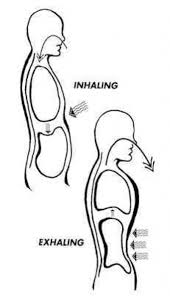 Breathing Mechanism Breathing Mechanism As we finish the holiday season and start on those New Years resolutions and begin that exercise regimen there is a main component that we all need to remember, and that is to breathe. The weekly blog is going to be a combination of Fundamental Movement (SM) and how we as Muscle Release Therapy, MRTh® practitioners look at the human body to assess pain related incidents. Our hope is that you find it informative and it helps guide you through your daily lifestyle.
Since this is being written for the general public as well as professionals there will be some over simplification and some complexity to the articles. Please feel comfortable to submit questions and comments for both clarification and answers to your specific issues. When teaching Muscle Release Therapy, MRTh® or Fundamental Movement Pilates (SM) the first item on the agenda is breathing. In therapy we look for any of the key components not functioning and in movement we emphasize the need to breathe properly. The body has a series of diaphragms or bellows that need to expand and draw in air and contract to expel air. In therapy it is important because without the proper breathing mechanisms working the tension on the skeleton will always be compromised. In movement it is important that anytime an individual exerts energy that they are in the process of exhaling. There are two items being served here, the first is we need to have oxygen in the blood for its nourishment as well as the tissue it services. Secondly, it sets all of the other components of movement in motion. The primary areas or diaphragms that the therapist should be assessing is the neck, mid-abdominal region and the pelvic floor. These are the three primary bellows that will draw in and expel air. An important note here is that not only do these diaphragms function in the breathing mode but on exertion will protect the neck and low back as it helps to stabilize. For the therapist this would be the Scalene muscles (neck), mid abdominal diaphragm and oblique muscles (rib cage), the Psoas major and minor (hip flexor and back) and the Adductor Magnus (inner thigh) for proper movement of the Pelvis. The neck acts as a diaphragm as on inhalation we shorten the muscles and exhalation we elongate the muscles. How does exhaling protect the neck, its primary goal is to decompress the vertebrae and take pressure off of the disc material and nerves. The belly diaphragm (see picture above) allows the lungs to expand as it draws in air and contracts to expel air. Notice though how the abdomen (stomach) region compresses during the exhalation process, this is to protect and decompress the low back so that pressure is taken off of the discs. The Pelvis diaphragm is the control center as it places the main support structure in the proper position to absorb the change in tension when we exert energy. When we inhale we should feel a normal tightness in both the neck and pelvic region and expansion of our belly. On the exhale, it will be just the opposite. These subtle movements set the base for all movement within the body. It is accomplished at a subconscious level and in times of mental or physical stress periods we often interrupt this natural pattern and hold our breath. It is at these times we need to consciously remember to breathe. Whether we are walking, running, biking, weight training, Pilates, Yoga, or some other form of exercise we need to also consciously exercise our breathing patterns. The easiest way to do this is to keep the jaw relaxed and not tighten or compress it. What this accomplishes is forced breathing patterns and will keep us in a normal breathing rhythm. If we need to clench our jaw, then we are doing something that is compromising the structure itself. All this will do is force the brain to use a part of the body it shouldn't be. The blog will continue to incorporate more on breathing during movement as we continue to explore other anatomy parts of the body. So until next time, practice your breathing, inhale pulling up through your feet all the way to your head and you will ensure that all the necessary parts will receive the oxygen it needs to function. If you are looking for that quiet spot to practice your breathing, remember our new Spirit Space is open for you, call and reserve your time at 216-364-0152, there is no cost for using this room, it is Marge's desire that we all find peace and solitude in it. So with every breath we take, remember there is always a REASON TO HOPE! Dennis |
CVWC25901 Emery Rd, Suite 103 Archives
|
 RSS Feed
